Implementation of a logical event. More...
#include <event.h>
Public Member Functions | |
| CEvent (const std::string &id) | |
| Constructor with parameters. More... | |
| CEvent (const std::string &id, bool create_signaled) | |
| Constructor with parameter. More... | |
| void | reset (void) |
| Function to reset the event. More... | |
| void | set (void) |
| Function to activate the event. More... | |
| void | wait (int timeout_us) |
| Function to wait for the activation of the event. More... | |
| bool | is_set (void) |
| Function to check the state of the event. More... | |
| int | get_num_activations (void) |
| Function to get the number of event instances. More... | |
| std::string | get_id (void) |
| Function to get the event identifier. More... | |
| int | get_fd (void) |
| Function to get the read file descriptor of the pipe. More... | |
| virtual | ~CEvent () |
| Destructor. More... | |
Protected Member Functions | |
| void | set_id (const std::string &id) |
| Function to set the event identifier. More... | |
Detailed Description
This class implements the features of a logical event that can be signaled and waited for from different threads or processes. This class has a CMutex object to avoid race conditions while signaling and waiting for the event. The event is created inactive by default, but it is possible to create it already signaled with additional parameters of the constructor.
Each event has a unique identifier which is as string with a simple description of the event that is used to identify the event. This identifier is passed by at construction time and can not be modified afterwards.
The event is implemented as a pipe which can be written to (signal the event) and read from (reset the event). The event is signaled by calling the set() function. If this function is called several times, all the instances are stored in the pipe. The is_set() function can be used to check wether there are instances of the event in the pipe (the event is active) or not (the event is not active).
Finally, the reset() function removes one of the event instances from the pipe. If there are several instances of the event stored, only one is removed from the pipe, and when the last instance is removed from the pipe, the event is no longer active. The function get_num_events() can be used to check how many events are pending in the internal pipe.
The use of a pipe make it easy to implement wait functions because it is possible to use the select() function on the read file descriptor of the pipe. Therefore, to peform a wait on a set of events, it is necessary to return the read file descriptor of the pipe.
Objects of this class can be used alone or they can be handled by an event server implemented by the CEventServer class. See the documentation of this class for a more detailed description.
This class uses exceptions to report errors. The name of the exception class associated to this class is CEventException. See the corresponding documentation for a more detailes description.
- Examples:
- test_events.cpp.
Constructor & Destructor Documentation
| CEvent::CEvent | ( | const std::string & | id | ) |
This constructor is used to create an initially inactive event with a given identifier. The values of the class attributes after this constructor is called are:
- pipe_fd[0] = read file descriptor of the pipe.
- pipe_fd[1] = write file descriptor of the pipe.
- num_events = 0.
- event_id = event identifier.
- access = a new mutual exclusion object.
This function throws a CEventException if there is an error. See the corresponding documentation for a more detailed description of these exceptions.
- Parameters
-
id a null terminated string with the event identifier. The identifier is stored internally in a different memory location so that the parameter can be freed after calling this constructor. The identifier must not have any spaces or special characteres.
Definition at line 28 of file event.cpp.
References set_id().

| CEvent::CEvent | ( | const std::string & | id, |
| bool | create_signaled | ||
| ) |
This constructor is used to crate a new event which can be active by default with a given identifier. The behavior of this constructor is equivalent to the first constructor except that depending on the value of init_state, the event is active or not by default.
This function throws a CEventException if there is an error. See the corresponding documentation for a more detailed description of these exceptions.
- Parameters
-
id a null terminated string with the event identifier. The identifier is stored internally in a different memory location so that the parameter can be freed after calling this constructor. The identifier must not have any spaces or special characters. create_signaled a boolean that indicates if the event must be active by default ($1$) or not ($1$).
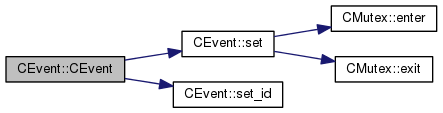
Definition at line 42 of file event.cpp.
References set(), and set_id().
|
virtual |
This destructor safely frees all the allocated memory and destroys the mutual exclusion method.
This function throws a CEventException if there is an error. See the corresponding documentation for a more detailed description of these exceptions.
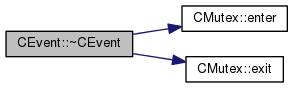
Definition at line 171 of file event.cpp.
References CMutex::enter(), and CMutex::exit().
Member Function Documentation
|
protected |
This function sets the unique event identifier for each event. This function is protected, and therefore can only be executed inside the class, because the identifier can not be modified after construction of the event.
This function throws a CEventException if there is an error. See the corresponding documentation for a more detailed description of these exceptions.
Definition at line 145 of file event.cpp.
Referenced by CEvent().

| void CEvent::reset | ( | void | ) |
This function reads a byte from the internal pipe to reset the event. If there is only one instance of the event in the internal pipe the event become inactive, but if there are several instances of the event, its state does not change, and only the number of pending event is decreased.
Internally, the mutex is locked and released to avoid race conditions when several threads are trying to activate or reset the event.
This function throws a CEventException if there is an error. See the corresponding documentation for a more detailed description of these exceptions.
- Examples:
- test_events.cpp.
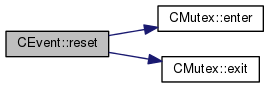
Definition at line 58 of file event.cpp.
References CMutex::enter(), and CMutex::exit().
Referenced by wait().

| void CEvent::set | ( | void | ) |
This function writes a byte to the internal pipe to activate the event. If the event is currently inactive, it is activated, and if it is already active its state does not change, except for a new instance of the event in the pipe.
Internally, the mutex is locked and released to avoid race conditions when several threads are trying to activate or reset the event. Each time this function is called, the number of event instances is incremented by $1$.
This function throws a CEventException if there is an error. See the corresponding documentation for a more detailed description of these exceptions.
- Examples:
- test_events.cpp.
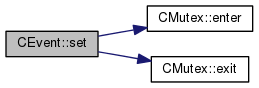
Definition at line 76 of file event.cpp.
References CMutex::enter(), and CMutex::exit().
Referenced by CEvent().

| void CEvent::wait | ( | int | timeout_us | ) |
This function waits for the activation of the event for a given period of time. If the event is not active after the desired time elapses, the function returns anyway, throwing an exception.
If no timeout is desired, any negative value will be interpreted as an infinite wait time. Passing a negative parameter is possible but not recomnded because it may block a thread forever.
When the event is activated, all the threads blocked in a wait() function for the activated event will awake, and the evetn will be automatically reseted.
- Parameters
-
timeout_us Tis is an integer which indicates the desired timeout value in micro-seconds. This value may be negative if no timeout is desired.
This function throws a CEventException if there is an error. See the corresponding documentation for a more detailed description of these exceptions.
- Examples:
- test_events.cpp.
Definition at line 91 of file event.cpp.
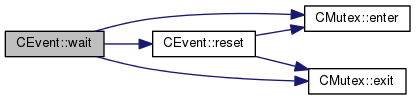
References CMutex::enter(), CMutex::exit(), and reset().
| bool CEvent::is_set | ( | void | ) |
This functions checks wether the event is active ($1$) or not ($0$), but it does not take into account if there are several instances of the event in the internal pipe. This function does not change the internal state of the event.
This function throws a CEventException if there is an error. See the corresponding documentation for a more detailed description of these exceptions.
- Returns
- A boolean that indicates if the event is set (true) or not (false).
- Examples:
- test_events.cpp.
Definition at line 129 of file event.cpp.
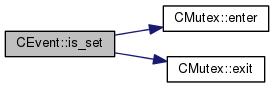
References CMutex::enter(), and CMutex::exit().
| int CEvent::get_num_activations | ( | void | ) |
This function returns the number of instances of the event currently in the internal pipe. This function does not change the number of instances of the event in the pipe.
This function throws a CEventException if there is an error. See the corresponding documentation for a more detailed description of these exceptions.
- Returns
- An integer with the number of insatnces of the event in the pipe- There is no limit in the number of events that can be stored in the pipe.
- Examples:
- test_events.cpp.
| std::string CEvent::get_id | ( | void | ) |
This fucntion returns the event identifier of the event as a null terminated string.
This function throws a CEventException if there is an error. See the corresponding documentation for a more detailed description of these exceptions.
- Returns
- A reference to a non-allocated memory space where the identifier of the event is to be copied. The necessary memory is allocated internally to match the size of the identifier. The calling process is responsible of freeing the allocated memory.
- Examples:
- test_events.cpp.
| int CEvent::get_fd | ( | void | ) |
This function returns the read file descriptor of the internal pipe. This file descriptor must not be used anywhere except to wait for several events simultaneously. Closing the returned value will cause unexpected errors.
- Returns
- An integer with the read file descriptor of the internal pipe.
The documentation for this class was generated from the following files: